My blogging history:
2012: diagnosed with and underwent treatment for Primary CNS lymphoma in my brain.
2012-2013: blogged on Caring Bridge.
2013: moved to Blogger.
2017: diagnosed with bladder cancer and blogged through 14 chemotherapy treatments and 37 sessions of radiation therapy, each with its own t-shirt and musical selection.
2018 to February 2020: Treated every 3 weeks with pembrolizumab for spread of bladder cancer to lymph nodes. As of June 2020, continue to be cancer free.
Thanks to my sister
Wendy for passing along the following clip from the 29th November 1965
edition of The Berkshire Eagle, a Pittsfield, MA paper which has been published daily since 1892.
And no Thanksgiving
would be complete without listening to Arlo himself, here performing his iconic
song at the 2005 Farm Aid benefit concert.
We had a lovely Sunday. In the
afternoon we went to see “A Beautiful Day in the Neighborhood,” a film based on
the life of Fred Rogers. Mr. Rogers was played by Tom Hanks, who really did an
amazing job of capturing his voice, body language, and facial expressions. It
was almost uncanny, and after a few moments you could easily believe you were
in fact watching Mr. Rogers! I believe that the story is based on actual events
in the life of Fred Rogers. It centered around the relationship between Mr.
Rogers and journalist Tom Junod, played by Matthew Rhys), who reluctantly
accepted an assignment from his editor at Esquire Magazine to write a
profile of Fred Rogers. He started the task with a combination of annoyance and
cynicism, but Mr. Rogers managed to turn the tables on the reporter and quickly
became the one asking the questions and ultimately helping Mr. Junod come to
terms with the sources of pain and anger in his own life. Although the movie
became a bit sappy towards the end, this did not significantly detract from the
beautiful story and the amazing acting. Unlike the beloved television show,
this is not a film for children, but certainly one for adults who share Fred
Rogers’ love of children.
We had a quick dinner and then headed over to the 92nd Street Y to a discussion between David Rubenstein, co-founder of the Carlyle Group, and Doris Kearns Goodwin, the Pulitzer Prize-winning historian, on the topic “what can the great leaders of the past tell us about today’s critical times?” By way of background:
David M. Rubenstein is a co-founder and co-executive chairman of the Carlyle Group, one of the world’s largest and most successful private equity firms. Mr. Rubenstein is Chairman of the Boards of Trustees of the John F. Kennedy Center for the Performing Arts, the Smithsonian Institution and the Council on Foreign Relations. Mr. Rubenstein is an original signer of The Giving Pledge and a recipient of the Carnegie Medal of Philanthropy and the MoMA’s David Rockefeller Award, among other philanthropic awards. The host of The David Rubenstein Show on Bloomberg TV and PBS, he lives in the Washington, DC area.
Doris Kearns Goodwin’s interest in leadership began more than half a century ago as a professor at Harvard. Her experiences working for LBJ in the White House and later assisting him on his memoirs led to her bestselling Lyndon Johnson and the American Dream. She followed up with the Pulitzer Prize-winning No Ordinary Time: Franklin & Eleanor Roosevelt: The Home Front in World War II. Goodwin earned the Lincoln Prize for the runaway bestseller Team of Rivals, the basis for Steven Spielberg’s Academy Award-winning film Lincoln, and the Carnegie Medal for The Bully Pulpit, the New York Times bestselling chronicle of the friendship between Theodore Roosevelt and William Howard Taft. Her latest book is Leadership: In Turbulent Times.
They’ll discuss Rubenstein’s new book, The American Story: Conversations with Master Historians, which takes us on a sweeping journey across the grand arc of the American story through revealing conversations with today’s greatest historians, Goodwin on Abraham Lincoln; David McCullough on John Adams; Jon Meacham on Jefferson; Robert Caro on Johnson; Bob Woodward on Nixon, and more. Goodwin’s recent book is Leadership: In Turbulent Times, a highly acclaimed New York Times bestseller, which draws upon the presidents she has studied most closely to show how they recognized leadership qualities within themselves and were recognized as leaders by others.
Nothing I could possibly write here would do justice to their fascinating discussion. I do not consider myself a history buff by any means but this really was quite a moving evening. Particularly memorable was Ms. Goodwin’s outline of the six essential traits a president needs:
And here is a clip from a recent interview on “CBS This Morning.”
As we head into the Thanksgiving holiday and weekend, let us all try to be mindful that the things that tie us together as a human race are far more important than the things that tear us apart.
Let me just say at
the outset that I am not a lawyer, have never studied law, and therefore cannot
in any way claim that what I am about to write here has any veracity.
We have been hearing
endlessly about an alleged “quid pro quo.” On
the assumption that much of the American public is not able to absorb the
meanings of Latin phrases, let alone recognize that they are long established concepts
in our legal system, the media and politicians have come to focusing on bribery
and extortion, which I suppose they assume people can better understand.
The
way quid pro quo is being used currently is based on the definition of
this term as referring to a favor or advantage granted or expected in return
for something. But in that case, is quid pro quo the right phrase to use
to describe the actions of which the President is being accused? I am not quite
sure how this came to be the misdeed of which Mr. Trump is accused, although it
may well have been his own insistence that there was “no quid pro quo
here.”
The
main reason given by the House of Representatives for moving toward impeachment
comes from a well-documented conversation between President Trump and Volodymyr
Zelensky, the Prime Minister of Ukraine. In response to Mr. Zelensky’s request to
President Trump to release the aid package previously promised to Ukraine, the
President said “I would like you to do us a favor though.” The particular favor
for which the President was seeking Ukraine’s assistance was providing negative
information on the former Vice President of the United States and current
candidate for President, Joe Biden, and his son Hunter.
So
how does all of this relate to impeachment? Impeachable offenses fall into the
following categories:
Bribery:
the offering, giving, soliciting, or receiving of any item of value as a means
of influencing the actions of an individual holding a public or legal duty
Treason:
the crime of betraying one's country, especially by attempting to kill the
sovereign or overthrow the government
and
Other
high crimes and misdemeanors: allegations of misconduct by officials. Offenses
by officials also include ordinary crimes, but perhaps with different standards
of proof and punishment than for non-officials, on the grounds that more is
expected of officials by their oaths of office. Indeed, the offense may not
even be a breach of criminal statute.
The
first category would seem to be most relevant in this case. It will ultimately
be in the hands of the American people and our elected officials to determine
whether any of the President’s actions meet this definition.
But simply the
fact that we are having this discussion, although perhaps an interesting civics
lesson, is an incredibly sobering thought. Having spent perhaps too much of the
past two weeks absorbed in watching the hearings, I can only say that the
return on Friday of “The Price is Right” on daytime television was a most
welcome relief!
Overfour days last weekend, basketball teams from Jewish high
schools all over the country travelled to Los Angeles for the 5th
annual Steve GloubermanZ”L(an avid basketball player and fan who unfortunately died four
years ago at the age of 46, leaving a wife and three children) Basketball
Tournament.
Last week, Joshua travelled with the
Maimonides High School basketball team to play in the 5th annual Glouberman
Tournament. The M-Cats, as the team is known, had an impressive showing,
winning 3 of their 4 games.
The games at JCC and Shalhevet were
made available through a video link, and we managed to watch them. Joshua
continues to be the youngest member of the team but he played more this year
than last, so it was quite a thrill to see him on TV! With the three-hour time
difference, the Friday game, which had been neck and neck the entire time,
ended just minutes before the start of Shabbat on the east coast.
We still had a lovely Shabbat.
Simmie and family came to our apartment for dinner, and we had Shabbat
lunch with Dina and family (minus Joshua, of course). On Sunday we had brunch
with one of our “old” friends and former Sharon neighbor. Hilary’s first husband,
Barry Z”L, died four years ago, and she recently married a fellow who
had also been widowed. It was really wonderful to meet Bob and get to spend
some time with both of them.
Barry barbequed for all twelve of us when
Joshua returned on Sunday evening. We headed back to New York on Monday morning.
I had a couple of relatively quiet
days, and then spent the better part of Wednesday at MSKCC, where I had a scan
which looked good (yeah!), saw Dr. Iyer, and received my pembrolizumab
treatment. Pretty much every room in the unit had the TV tuned in to the impeachment
hearings. I would rather have been watching “The Price is Right”!
“Where’s My Roy Cohn?” is reportedly
what President Trump said to federal investigators who were looking into
interference in the 2016 presidential election. Roy Cohn was Mr. Trump’s one-time
personal attorney who was known for his ruthlessness and apparent lack of concern
with ethics.
There have been a number of plays and
films about Mr. Cohn, including Tony Kushner’s “Angels in America,” which
premiered in 1991. This current film is a documentary, and includes extensive
interviews with some of Mr. Cohn’s accomplices as well as lawyers, journalists,
lovers, and younger members of his extended family.
There are many famous cases covered in
the film, including Mr. Cohn’s key role on the team prosecuting Julius and Ethel
Rosenberg for espionage, during which he is now known to have made phone calls
to the judge urging the execution of the couple that eventually took place on
June 19th of 1953.
There is no question that he was a
brilliant man. He graduated from Columbia University Law School at the age of
20, and had to wait a year to take the bar exam because one must be 21 years
old to do so. He was also amazingly clever, and although it is hard to be
overly impressed by this, he had an uncanny ability to convincingly state clear
falsehoods. He was a homosexual in the days before it became acceptable to openly
admit this. Many people flocked around him, at least until it became known, despite
his denials, that he was infected with the AIDS virus. It was quite stunning
how quickly all those admirers abandoned him at that point.
The film is quite a fascinating documentary about a man who had so much potential to have done good in this world but unfortunately took a very different path.
The seventh game of
the annual championship series of Major League Baseball in North America, known
as the World Series, will be played tonight, with the Washington Nationals
playing against the Houston Astros. In the first six games, the Astros won the
three played in Nationals Park in Washington, DC, while the Nationals won the
three played at Minute Maid Park in Houston, Texas. Tonight’s game is to be
played in Houston, which perhaps does not bode well for the Astros.
Why am I writing
about this? Because while hearing so much about the world series, something about
which I had never given much thought is the status of the nation’s capital,
Washington DC. Although the District of Columbia has a larger population than two
states (Wyoming and Vermont), because it is not one of the fifty states, it has no senators and only one delegate with limited voting privileges in the House of Representatives. Delegates have a marginalized role in Congress and their constituents are not represented in Congress in the same manner as most citizens.
There are currently
six non-voting members of Congress: a delegate representing the federal
district of Washington DC., a resident commissioner representing Puerto Rico,
and one delegate for each of the other four permanently inhabited US territories: American
Samoa, Guam,
the Northern Mariana Islands, and the US Virgin Islands.
The Twenty-third
Amendment to the United States Constitution, adopted in 1961,
entitles the District of Columbia to three electoral votes, the same number as
that of the least populous state, in the election of the President and Vice President.
Eleanor Holmes Norton,
a Democrat who has served since January of 1991 and is next up for reelection
in 2020, is the Representative for the District of Columbia’s At-Large District.
I have heard her name many times but never realized just what role she plays.
The District's lack
of voting representation in Congress has been an issue since the capital's
founding in July of 1790. Numerous proposals have been introduced to change
this situation, including legislation and constitutional amendments, returning the District to
the state of Maryland, and making the District into a new state. All such proposals
have been met with political or constitutional challenges, and there is no
indication that this will be remedied any time soon.
Whatever may be its
ultimate identifier, we know that Washington, DC is here to stay because they
have a major league baseball team! Who would have thought that an interest in
baseball would lead to a lesson on our system of government?
We headed into the
City first thing this morning for my MRI at the Memorial Sloan Kettering Cancer
Center building on East 55th Street, followed by my appointment with
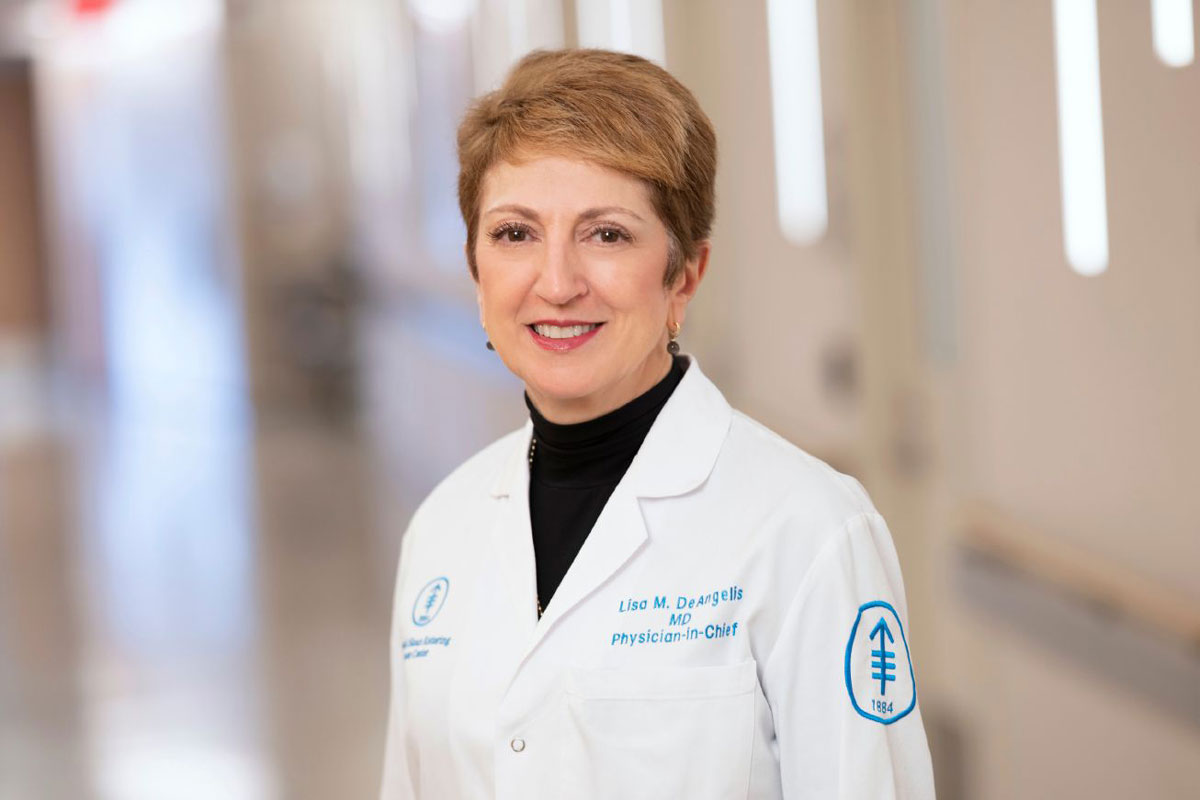
Dr. Lisa DeAngelis at the Outpatient Pavilion on East 53rd Street.
My last MRI had been on February 6th of 2018, nearly twenty-one
months ago.
The news is good – I
am still in the clear! So, after we chatted for a few minutes, it was not
entirely surprising when Dr. DeAngelis said that there is no need for me to
schedule any further routine follow-up appointments with her.
I first saw Dr. DeAngelis
in the spring of 2012. The primary CNS lymphoma had been diagnosed at Mount
Sinai Hospital, but because it is a relatively rare tumor, the doctors and
staff there did not have much experience treating it, and much to their credit,
those doctors encouraged us to head over to Dr. DeAngelis at MSKCC. The rest,
as they say, is history.
As I was writing
this, I entered “Lisa DeAngelis” into Google and lo and behold came across
something I had somehow completely missed earlier last month:
Neuro-Oncologist Lisa M. DeAngelis Has Been Named
Physician-in-Chief and Chief Medical Officer of Memorial Sloan Kettering Cancer
Center
Lisa
M. DeAngelis Has Been Named Physician-in-Chief and Chief Medical Officer of MSK
Tuesday, September 10, 2019
After an extensive nationwide search, Memorial Sloan
Kettering Cancer Center (MSK) announced today that Lisa M. DeAngelis has been named
Physician-in-Chief and Chief Medical Officer. A leading expert in brain cancer,
Dr. DeAngelis previously served as Chair of the Department
of Neurology and was co-founder of MSK’s Brain Tumor Center during her
30-plus-year tenure at the institution.
“Lisa is an internationally renowned physician,
collaborative colleague, and fierce advocate for both patients and faculty,”
said Craig B. Thompson, MSK President and CEO. “Her
expertise and unique understanding of MSK’s mission make her the ideal person
to lead MSK’s clinical enterprise into the future.”
As Physician-in-Chief, Dr. DeAngelis will direct the entire
clinical care enterprise and continuum of care at MSK, leading a staff of
cancer experts that includes more than 1,200 hospital attendings and almost
4,000 registered nurses. She will be responsible for the management of all
patient care services across the MSK system, including a 500-bed inpatient
hospital, 13 outpatient facilities in New York City, and seven regional care
sites throughout New York and New Jersey. She will also focus on clinical
strategic planning and will oversee MSK’s robust clinical and translational
research programs.
“Over the course of her career, Lisa has been a leader of
strength and integrity and is widely recognized for her vast knowledge of MSK,
her extensive experience in treating cancer, and her extraordinary skill as a
physician. She is also a gifted communicator, and there is no one better suited
for this trailblazing role,” said Scott M. Stuart, Chairman of the Boards of
Overseers and Managers of MSK.
Dr. DeAngelis joined MSK as a neuro-oncology fellow in 1985,
working with Jerome Posner, who was MSK’s founding Chair of Neurology. She
became a critical member of MSK’s leadership team in 1997, when she was
appointed Chair of the Department of Neurology, a position she held until
assuming the Acting Physician-in-Chief role in September 2018. She co-founded
MSK’s Brain Tumor Center, where experts from across MSK work to bring new
discoveries from the lab to patients as quickly as possible. Her research has
focused on primary brain tumors and the neurological complications of cancer
and its treatment, such as cognitive impairment and strokes. She helped develop
the current regimen to treat primary central nervous system lymphoma and has led
numerous national clinical trials that investigate new brain tumor therapies.
MSK
is one of 50 institutions in the United States that has been designated a Comprehensive Cancer Center by the National Cancer
Institute, affirming our leadership in research, patient care, and
education. MSK is an American Nurses Credentialing
Center Magnet®–designated institution, based on nursing excellence. In
2018, more than 24,000 patients were admitted to Memorial Hospital, and more
than 173,000 patients were seen at our Manhattan and regional facilities.
From where I sit,
MSKCC would have been hard pressed to make a better selection!