With all that has gone on the last six months or so, you may
have forgotten that my close up and personal relationship with cancer began almost
six years ago with the diagnosis of primary CNS lymphoma in my brain. Yesterday
was my long-ago scheduled follow-up MRI and visit with Dr. Lisa DeAngelis, the
neuro-oncologist who oversaw my treatment back in 2012. I am glad to say that
the news was good, although Dr. DeAngelis is now wondering how it is that the
lightning that had already struck twice
has now struck a third time. We
agreed to wait a year and a half for the next follow-up visit. The neuro-oncology
group has me scheduled for August 2019 but I have requested pushing it off
until after Labor Day so that we can keep August available for our
grandchildren.
Meanwhile, I am scheduled for further testing on the bladder
lesion next week, as well as routine follow-up with my pulmonologist. Right now,
I am glad that all that is on my calendar for tomorrow is routine oxygen
delivery, and, if possible, I will go to a class or two at Hebrew Institute of
Riverdale.
Every time we visit Dr. DeAngelis the routine is the same.
First, the MRI, then we wait to see the doctor. Before Dr. DeAngelis arrives, one
of the neuro-oncology residents does a routine follow-up evaluation, including
those annoying memory tests. Yesterday she asked me to remember three words:
apple, tiger, and love. Barry later shared with me that he used those
techniques from Joshua Foer’s book, “Moonwalking with Einstein” to remember the
words. I still have a hard time with this exercise, and had to ask Barry for
help in order to write this!
What did stick with me in this visit was my impression of
the neuro-oncology resident herself. She is, and there is no gentle way to put
this, morbidly obese, unusual to see in a young physician. Her excessive weight
was only compounded by her overall unkempt look, including ill-fitting clothing.
This was in stark contrast to Dr. DeAngelis, who always looks like she just stepped
out of the pages of a fashion magazine for highly intelligent professional
women. I know this is grossly unfair, and the fact that this young woman is a
resident at MSKCC tells me that she is an extremely bright and capable
physician. But it is sad to think that her career may well be less successful
than her intelligence should allow.
Sometimes one thing leads to another, and as I was writing
this I went back to look for a picture of Dr. DeAngelis when I came across this
article on the MSKCC web page:
Halina’s Story about Primary Central Nervous System
(CNS) Lymphoma
Around
New Year's Eve, Halina Frydman’s husband noticed changes in his wife's
personality. Soon after, she was diagnosed with primary central nervous system
lymphoma, which arises in lymphocytes, a type of white blood cell. She came to
Memorial Sloan Kettering to receive treatment through a clinical trial.

Can
a husband dance too much with his wife on New Year’s Eve?
Roman
Frydman’s motives for dancing the night away with his wife, Halina — while
loving — were not entirely to ensure that she would have a good time at a New
Year’s party welcoming 2005. Instead, he was concerned about recent, disturbing
personality changes he had observed in her — including uncharacteristic anger
toward a friend attending that night’s celebration.
“My
husband danced with me a lot that evening because he didn’t want me to interact
with too many people,” says Dr. Frydman. “He recognized there was something
wrong.”
Several
days later, in her office at New York University’s Stern School of Business,
where she is a professor of statistics, Dr. Frydman realized she was unable to
focus on her work. Returning to her apartment, she tried to read a book. Her
husband, also a professor at NYU, asked what she was reading.
“I
couldn’t tell him,” Dr. Frydman recalls. “That’s when he got very upset and
called a friend, a psychiatrist, who said, ‘Take Halina to the emergency room
now.’”
At
NYU Medical Center, an MRI scan of Dr. Frydman’s brain showed a tumor.
Immediately admitted to the hospital, she began a course of steroids. The tumor
shrank dramatically.
She
explains: “At first, the doctors suspected it was a metastasis from the breast
cancer I had in 1999. But because it shrank so much and so fast, they thought,
‘This is not a solid tumor.’”
A
brain biopsy followed and finally a diagnosis: primary central nervous system (CNS) lymphoma.
Dr. Frydman had been treated for breast cancer at Memorial Sloan Kettering by
medical oncologist Clifford A. Hudis (now Chief of the
Breast Cancer Medicine Service) and wished to be treated at the Center again.
Dr.
Hudis referred the Frydmans to neuro-oncologist Lisa M. DeAngelis, Chair of the Department of
Neurology and now Co-Executive Director of the Brain Tumor Center.
“CNS
lymphoma is a rare cancer that can involve the brain, spinal cord, eyes, or the
coverings of the brain and optic nerve, called the meninges,” says Dr.
DeAngelis. “The designation of the disease as a lymphoma reflects the fact that
the cells from which this cancer arises are lymphocytes, a type of white blood
cell.”
What we have learned is that underlying
brain tissue is not necessarily destroyed by tumors; therefore effective
treatment really can restore people to functionality.
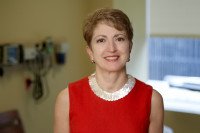
Lisa M. DeAngelis Neuro-oncologist
Dr.
DeAngelis enrolled Dr. Frydman in a clinical trial consisting of methotrexate —
a chemotherapy drug that was given in very high doses — along with the
chemotherapy drugs vincristine and procarbazine, and a monoclonal antibody
called rituximab.
“CNS
lymphoma of the type that Dr. Frydman had used to be treated with whole-brain
radiation, which can damage normal brain structures and affect cognitive
function,” explains Dr. DeAngelis. “At Memorial Sloan Kettering, we’ve
pioneered the use of chemotherapy for these tumors. Although radiation
continues to play a role, we are exploring significantly reducing the doses. In
patients who have received chemotherapy and low-dose radiation we don’t see
cognitive damage and the majority of them are doing extraordinarily well.”
The
protocol for the trial still called for whole-brain radiation, albeit at a
reduced dose. However, following chemotherapy, a scan of her brain showed no
signs of cancer and Dr. Frydman decided against it.
“I
was worried that I wouldn’t have been able to go back to my work,” says Dr.
Frydman. “I asked Dr. DeAngelis, ‘In your opinion, if I don’t do the radiation,
will I put myself at a higher risk of a recurrence?’ She said no. She was very
open-minded about it.”
“Dr.
Frydman had gone into complete remission and had made a full clinical
recovery,” says Dr. DeAngelis, “so I felt I could support her decision.”
Dr.
DeAngelis concludes, “What we have learned — and lymphoma is one of the best
examples of this — is that underlying brain tissue is not necessarily destroyed
by tumors; therefore effective treatment really can restore people to
functionality.”
Halina
Frydman has certainly been restored. She has returned to a full life of
teaching, researching, writing, and publishing. And today, she and her husband
dance just for the fun of it.
Another statistician with primary CNS lymphoma. I am glad
she has had such a positive outcome and even returned to her work. Maybe Barry
and I should go out dancing!
Love,
Rebecca

No comments:
Post a Comment